Here’s what I keep seeing behind the scenes of “successful” AI programs.
If your AI roadmap doesn’t change how your team works on Monday morning, it’s just an expensive PDF. Let me be direct: the 2024 playbook of “strategy first, execution later” is completely dead. The gap between having an AI idea and deploying a working agent has collapsed to near zero.
In December 2025, execution isn’t what happens after strategy. Execution is the strategy.
The Shift That Changed Everything
Three changes this past quarter leveled the playing field faster than most companies realized. They’re architectural shifts that fundamentally changed what AI can do without human intervention.
From Chat to Autonomous Action. We moved past AI that waits for prompts. The new wave assigns goals and grants access. Instead of asking an AI to draft an email, you give it a target, increase Q4 leads by 20%, hand it your CRM credentials, and let it run A/B tests while you sleep. The tool doesn’t wait for your next instruction. It operates.
Consider what this means in practice: A sales operations manager used to spend three hours weekly analyzing pipeline data and drafting outreach sequences. Now an agent does this continuously, adjusting messaging based on response rates and scheduling follow-ups when engagement drops. The manager reviews weekly summaries and adjusts strategy based on what the agent learned.
Time saved: 12 hours per month. Cost avoided: roughly $3,000 in operational overhead.
That’s tangible ROI!
From Bottleneck to Oversight. Human-in-the-loop made sense when AI was unreliable. But for low-risk, high-repetition tasks, that model just became friction. The shift this month is toward human-on-the-loop supervision. You define the necessary guardrails. The agent executes within them. You audit outcomes, not every decision.
The difference is profound. In the old model, your approval was required for every action. In the new model, you set rules, don’t spend more than $X, don’t contact prospects more than Y times per week, escalate if response sentiment drops below Z, and the system operates within those boundaries. You monitor dashboards. You adjust parameters. You don’t approve every email.
From Static Tools to Dynamic Swarms. Traditional AI tools are reactive—they wait for your input. The agentic systems launching in Q4 are proactive. They ask for help only when stuck. Multiple agents coordinate tasks, share context, and solve problems without constant human direction. The architecture changed from “tool” to “teammate.”
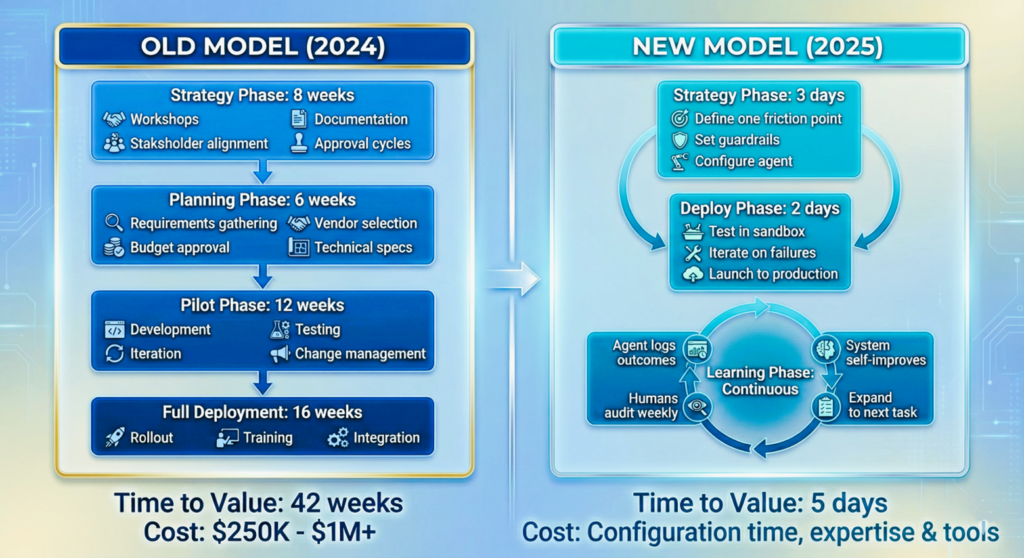
Where Value Lives Now vs. Then
What The Data Shows
The consultancy crisis is real. Firms that built businesses selling 12-month digital transformation roadmaps are struggling. Why? Because their clients can now configure custom operational agents in hours, not hire six-figure projects that deliver in quarters. The economic model that sustained traditional consulting, selling planning as a distinct phase from execution, collapsed when the implementation time dropped from months to days.
Platform economics are shifting too. New SaaS tools are pricing by task completed, not by user seat. When the business model moves from access to outcomes, it proves the market has already decided: execution is the only metric that matters.
The big tech pivot from “assistant” to “operator” tells the same story. Recent releases from OpenAI, Anthropic, and Google don’t ask “What do you want to do?” They ask “What outcome do you need?” Then they control the mouse, navigate the browser, and complete the task autonomously.
Your Move for Tuesday Morning
Don’t schedule another strategy session. Don’t commission another white paper on AI readiness.
Do this instead: Identify one friction point in your operations. Build or configure a single, narrow-purpose agent to handle it. Watch it fail. Adjust the prompt or the guardrails. Watch it succeed. Measure the time saved. Calculate the cost avoided.
That’s your strategy. Everything else is commentary.
The hard truth: if you’re still treating AI as a future-state initiative, you’re already behind organizations that are deploying, testing, and iterating daily. The advantage doesn’t go to the team with the best slides. It goes to the team that ships on Tuesday.
Coming up next time: I’ll walk through how to build your first autonomous agent without writing code. No lingo. Just the practical steps to move from planning to production.
What’s one operational task in your business that AI could handle this week?
Reply and let’s figure it out together!